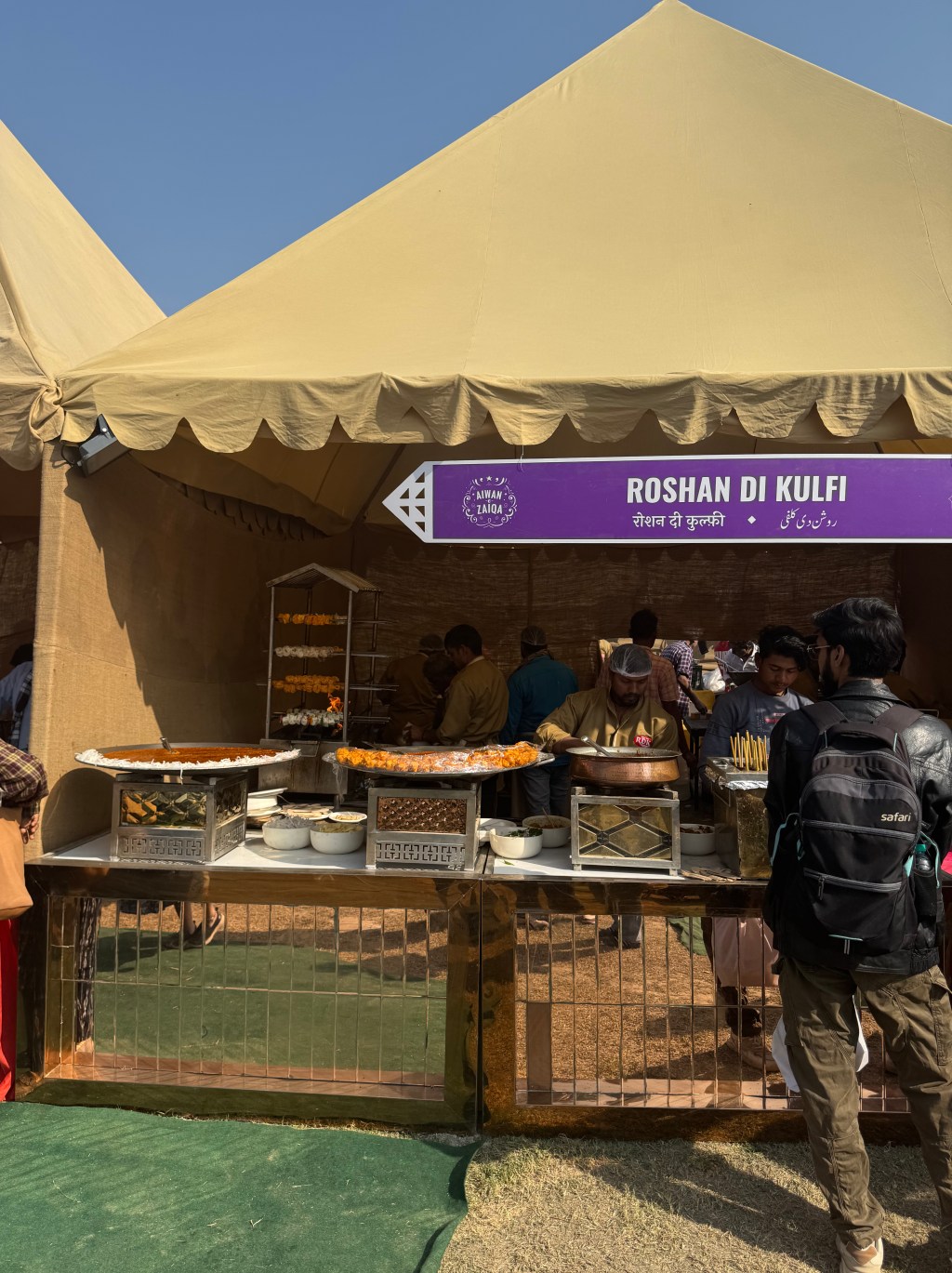
This All Started with an Instagram Comment
Two weeks ago, I came across an Instagram reel where a creator (Zoha Malik) was talking about a healthier version of Malai Kulfi that she had come up with. From the accent you could tell she was American Desi. At one point, she referred to Malai Kulfi as a South Asian dessert.
I was super excited to hear about the recipe until I heard the term “South Asian”, and right then and there, I knew, if I opened the comments, someone would be upset about why she said “South Asian” instead of “Indian.”
So of course, instead of learning a new recipe, I went down a rabbit hole of reading through the comments and getting rage baited by strangers on the internet.
To no one’s surprise, the first comment I saw said:
“South Asian? Indian. Thank you.”
Now at that point some people had already responded to her, but I had that itch to say something too.
I replied, trying (and honestly miserably failing I won’t lie) to explain a much bigger idea in a single comment. I said something along the lines of: India as we know it today didn’t exist before 1947, the region had multiple kingdoms, and malai kulfi itself has roots in Mughal culinary traditions, so calling it South Asian actually makes sense.
Before we even dive into how this inspired me to write today’s blog post, let me first also point out her response, which was:
“That’s why education is important.”
Ma’am… what?
Somehow, her shallow comment didn’t really surprise me, but it did for sure bruise my ego.
Not because I thought she was right, but because I realized how poorly I had explained what I was actually trying to say.
So here we are. Two weeks later. Writing a whole blog post instead of replying to an Instagram comment. How mature of me… I know right?
What I was trying to say, in a very messy way, is actually pretty simple now that I have time to write my thoughts out properly.
The idea behind my comment was that we often use today’s national borders to claim ownership over things that existed long before those borders did.
Modern countries like India, Pakistan, and Bangladesh are relatively recent, and hence “modern”. I mean as recent as 1947 for India and Pakistan, and 1971 for Bangladesh!
But (and that’s a big BUT) the cultures, traditions, foods, and so many other things we associate with them are much older. They come from a rich and shared historical and cultural space that existed long before these nations were formed.
So when someone calls malai kulfi “South Asian,” it’s not incorrect, it’s actually more accurate.
Because what does it mean to say something is “Indian”? Do we mean modern-day India, as a nation-state formed in 1947? Do we mean the broader subcontinent, which included regions that are now separate countries? Do we mean the empires and kingdoms that existed centuries ago, where cultures, people, and traditions constantly overlapped and evolved?
The truth is, a dish like malai kulfi doesn’t neatly belong to one modern country. It comes from a region with a deeply shared and entangled history. Mughal influence, regional variations, cross-cultural exchanges, none of these followed the borders we recognize today.
And that’s the point I was trying to make.
However, what really stood out to me even more than the comment itself was the instinct behind it, the same instinct I keep seeing in reels, tweets, and everyday conversations among many Desis now, over things like whether Saris are “South Asian” or just “Indian” (even though both Pakistani and Bangladeshi women wear saris), and so much more.
That instinct to get defensive the moment they hear “South Asian.”
Why did “South Asian” feel wrong to her? Why did it need to be corrected to “Indian”? What’s the harm in calling something South Asian? I mean technically India is in the region of South Asia (or how a lot of political scientists these days say – the Global South)… so what’s the problem?
Because, in my humble opinion, saying “South Asian” doesn’t take anything away from India. It doesn’t erase its Indian identity. It doesn’t diminish the pride we should carry for loving this delicious dish. It doesn’t mean that Indians can’t enjoy malai kulfi anymore because it’s not their.
If anything, it acknowledges something bigger, that a lot of what we celebrate as “ours” comes from a shared cultural history that spans across today’s borders.
And maybe that’s what makes people uncomfortable.
The idea of being grouped together as “South Asian.” Even though, in so many ways, our literature, our culture, our clothes, our food, and so many other things already tie us together.
Somewhere along the way, many of us have become so used to viewing everything through the lens of modern nationalism that we start projecting those boundaries backward. We take something that emerged in a very fluid, interconnected region and try to assign it to a fixed, modern identity.
And in doing so, we lose the beautiful nuance that makes our history what it is.
Take something like Dosa. You could argue that calling it South Asian feels too broad, because we know it’s deeply rooted in South India. It didn’t come from Bangladesh or Nepal, and in that case, being specific actually matters.
And that’s fair perhaps.
But that’s exactly what makes this whole thing more nuanced, not less.
Because not every dish has that same kind of clear, traceable origin. Malai kulfi doesn’t sit as neatly within one place the way something like dosa might. Its history is shaped by overlapping influences, movement, and exchange across the subcontinent.
And even in cases like dosa, where origins are more clearly tied to South India, that doesn’t mean others can’t claim it too. One could argue that Sri Lankans, for example, should acknowledge that they’re eating an “Indian” dish, but that’s the whole point. Maybe Sri Lanka wasn’t where dosa was first made, but it’s a place where it has been adopted, adapted, and made their own. So they don’t always need to acknowledge that Dosa is “Indian” and not Sri Lankan.
I ask myself this all the time: At what point does something stop belonging to one place and start belonging to everyone who has shaped it?
Recipes, languages, clothes so much of what we know today evolved because people moved, regions overlapped, and cultures blended long before anyone was drawing lines on a map in 1947.
So yeah, when this random lady who inspired today’s blog post insists on claiming something as strictly “Indian” or correcting “South Asian” to fit a modern label, she’s not really protecting her country’s history, she’s rather simplifying it.
Now, I could write a whole paper about why sentiments like this lady’s are becoming more and more common, why identity feels more fragile, why people feel the need to claim ownership so tightly, and why everything starts to feel like it’s at risk of being taken away.
But honestly, I think it comes down to something much simpler.
Somewhere along the way, we’ve gotten so used to fixed identities that we forget how fluid they actually are. And maybe that’s why there’s this instinct to hold on tighter, to label, to claim, to correct, because anything broader starts to feel like a loss, even when it really isn’t.
And maybe that’s what we all need to sit with a little more. Not everything has to be owned to be valued. Some things can just be shared. Sharing is caring after all.

 Anushka Das
Leave a comment