I woke up this morning, and of course the first thing I did was open up my Instagram feed, hoping that maybe, just maybe, I’d see some good news first before the usual flood of chaos. But I guess these days that’s a lot to ask for (or maybe I should be questioning what my algorithm is pushing).
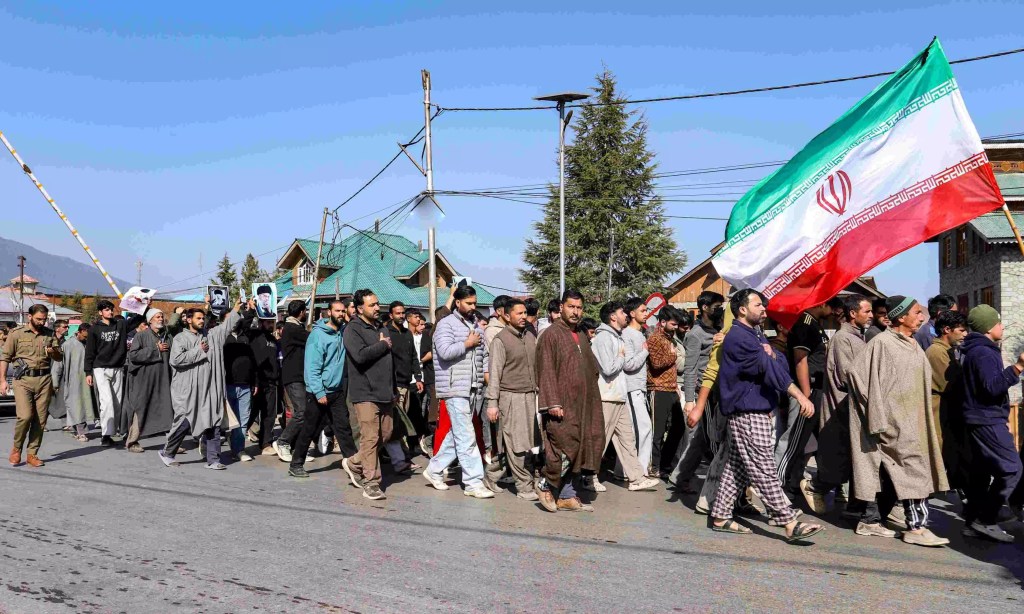
It wasn’t exactly “bad news” that I came across. It was a reel showing protesters across India, from Kashmir to Lucknow, reacting to the death of Iran’s Supreme Leader, Ayatollah Ali Khamenei. At first, I wasn’t even sure what I was watching. I was still half-awake, trying to figure out if they were protesting because they were happy? Or because they were grieving?
As I came out of my dreamy state, and doom scrolled a little more, a few more reels popped up on the same topic and I realized these protestors were taking to the streets to mourn him (whether we call it a protest or a mass mourning session, I’m still not entirely sure since I don’t really get what they’re “protesting” for).
I didn’t have an immediate emotional reaction to these reels, but watching so many of my fellow Indian citizens publicly grieve the death of a theocratic ruler, a man whose leadership was marked by widespread repression, limitations on basic freedoms, and human rights abuses (I mean the list goes on and on) forced me to take a little pause.
There was something ironic about living in a country that, for all its flaws, is far more democratic than Iran, and watching people mourn the passing of an illiberal regime’s leader…
So I started thinking.
One can demand pluralism at home and still feel transnational religious solidarity abroad. That part, I understand.
But I struggle to understand how religious solidarity could lead some people, from any community, to defend or sanctify authoritarian power, especially when the same voices demand pluralism and minority protections within their own democracy.
Transnational religious solidarity is powerful because, for many, it offers belonging beyond national borders. We see this everywhere. Catholics feel strong ties to the Vatican. Evangelicals mobilize around global Christian causes. Jewish diasporas mobilize around Israeli politics. Hindu diasporas rally around temple politics in India. And today, I was watching many Indian Muslims mourning the death of the Iranian leader killed by Israeli and U.S. forces.
In political theory, I was taught that religion, in many cases, often competes with the nation-state as a source of identity. People bond over shared history, shared narratives, shared civilizational belonging, and much more. Sometimes that bond feels stronger than citizenship itself. I get all that. I can even see why, in many contexts, it makes sense and is justified.
But here’s what I struggled with as I reflected on the images from the protests: when does solidarity require self-examination? When is it fair to question it? When should a community pause and ask whether identity attachment is preventing it from applying moral standards consistently?
Mourning an authoritarian ruler without acknowledging his authoritarianism looks like selective moral outrage to me.
If anyone chooses to be loud about justice, pluralism, minority rights, and democratic values at home, then their standards shouldn’t conveniently disappear when the figure in question shares some sort of religious identity with them.
Solidarity doesn’t have to mean blindness. It shouldn’t require suspending moral consistency.
Now, onto the matter of public protest briefly. Might I add that public protest is not a neutral act either. It’s a political act. When thousands take to the streets to mourn an illiberal ruler without grappling with the nature of his rule, it begins to look less like private grief and more like political endorsement. I might be wrong here or misunderstanding some motivations behind these protests, and I’m open to hearing a serious explanation. But right now, I’m trying to make sense of what I’m seeing.
So if this is grief, then my difficulty is understanding why it must take the form of public, organized “protest”. Grief can be personal. It can be quiet. When it becomes collective and confrontational, it carries a much deeper political meaning.
However, beyond that, I struggle with the moral framing of all of this – what standards are being applied here by these protestors? If the leader in question presided over repression, restrictions on dissent, and systemic limits on women’s rights, what exactly is being mourned? The man? The symbol? The politics?
And if it is some sort of political endorsement in the form of a “protest”, even symbolically, then it raises a lot of difficult questions about what ideals are being affirmed here… In a democracy where pluralism and minority protections are actively demanded (rightfully so in many cases), any sort of public alignment with authoritarian leadership inevitably creates tension and confusion honestly.
That’s where my discomfort lies.
And to be clear, I’m not here to debate whether U.S. or Israeli intervention was justified or not. That’s a whole other conversation that demands a separate blog or perhaps a book because there’s a LOT to be said there for sure…
I’m wondering out loud something different here.
Why are thousands of Indian citizens (especially women, what!?! ) publicly mourning a theocratic ruler whose record on women, dissent, and democracy was deeply illiberal?
Because if we demand pluralism and democratic protections at home, consistency requires that we apply the same moral lens globally.
And if you’re reading this thinking I’m just yet another person attacking the Indian Muslim community, I want to clarify something if it hasn’t been apparent so far… I’m questioning a pattern here, not a religion. I’m not disrespecting anyone’s faith.
My discomfort comes from my attachment to India (I mean I grew up there). I care deeply about its future. I care about South Asian politics, and I certainly above all care about what kind of democratic culture we’re building in the region. That’s where this reflection is coming from.
So, when I say I’m questioning a pattern and not a religion, I mean that this concern about uncritical solidarity applies to everyone. This isn’t about just or any one particular faith. It’s about a global pattern, how identity attachment, in any community, can slip into uncritical loyalty. And all of us are vulnerable to that.
I’ve had the same discomfort when I see sections of the Hindu community, for example, defend political leaders or policies simply because they are framed as “protecting Hindu identity,” even when those policies undermine democratic values. I’ve seen similar dynamics in Christian nationalist movements. I’ve seen it in many religious contexts.
When attachment to identity becomes so strong that it overrides moral scrutiny, the religion itself isn’t the issue, the uncritical attachment is!!
That’s the pattern I’m questioning.
To end this reflection, or this thinking-out-loud session, I’ll admit that after all this questioning, my brain immediately went into “solution mode.” Is there even a solution? And before that, have I clearly identified the problem? And if there is a solution, what would it look like in practice?
Maybe I need to go read more political theory before I can confidently attempt to answer any of these questions. But for now, I’m just going to dump a lot of questions here for you to ponder with me.
How do we build communities that can hold both solidarity and self-critique at the same time? How do we remind ourselves that religious belonging doesn’t require moral blind spots, that criticizing a leader, a regime, or even a movement associated with our broader community is not a betrayal of faith? Sharing a faith does not require defending every leader who claims to represent it.
If our faith in God and our religion is strong, it should survive scrutiny. It shouldn’t depend on uncritical attachment to political power.
How do we make it clear that moral consistency is not disloyalty, that scrutiny is not sacrilege?
Solidarity matters. But not at the expense of moral judgment. And that principle applies everywhere, to national solidarity, racial solidarity, gender solidarity, religious solidarity, whatever form it might take.
The question is whether we are brave enough to live by that consistently.

 Anushka Das
Leave a comment